Sales Returns Statement
On this page
The Sales Returns Statement lists the goods customers returned to you in a period: which customer, which item and batch, how many units, at what price and for how much. It can also set each return beside the sale it came from, so you can check what a customer was charged against what you took back.
Open the report
Press Alt+5 for Stock Reports, then M. The report opens for the financial year from its first day to today, grouped by customer.
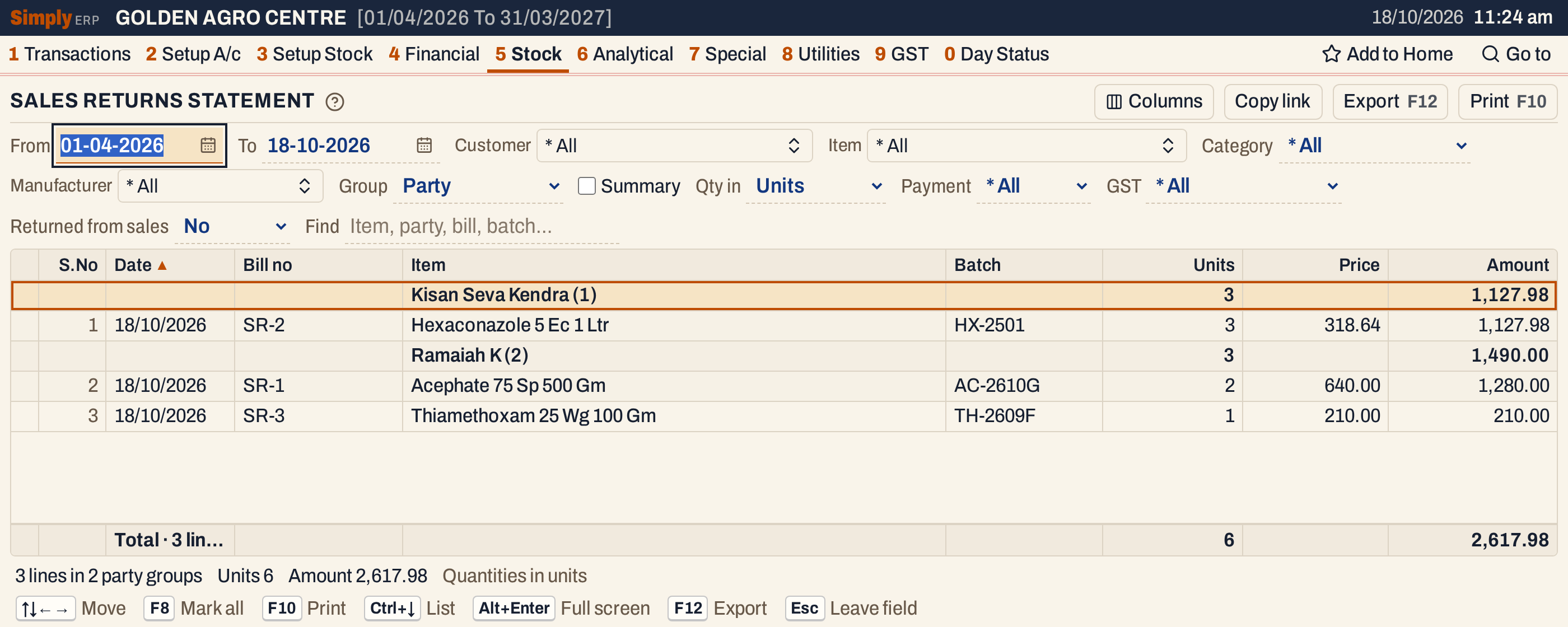 Each customer is a heading with the number of lines under it, its units and its amount. The totals line is under the grid.
What it lists
One line for each item line of each sales return whose Recd. date is in the period. A sales return is made on Transactions → G S T Outward (Direct) → New Entries with the Sales Returns bill type.
- Sales, purchases, purchase returns, notes and vouchers are left out.
- Charges and other lines that are not items are left out.
- A return of several items has one line for each item, with the same bill number.
The first day and the last day of the period both count. The books post a return on its Recd. date, the day the goods came back, which can be later than the return date; the report goes by that day and shows it. The customer’s name is the name on the return. When the return has a name under Ship to another, that name is shown instead.
Columns
| Column | What it shows |
|---|---|
| S.No | The line’s number in the list. Group headings are not numbered. |
| Date | The day the return was received (its Recd. date). |
| Bill no | The number of the return bill. |
| Customer | The customer’s name. Shown when the report is not grouped by customer; when it is, the name is on the group heading. |
| Item | The item’s name. When the report is grouped by item, the name is on the group heading. |
| Batch | The batch the goods came from. Shown only when at least one line has a batch. |
| Units | The quantity returned. |
| Price | The unit price on the return line: without GST when the customer has a GSTIN, with GST included when not. Blank on group headings and the totals line. |
| Amount | The value of the line, with GST. |
| Sale bill, Sale date, Sale qty, Sale price, Sale amount | The sale the return was matched to: its bill number, date, units, price as billed and net amount with GST. Shown only when Returned from sales is Dealers or Farmers. |
The status line under the grid gives the number of lines and groups, the total units and the total amount, and says which unit the quantities are in.
Choices
| Choice | What it does |
|---|---|
| From, To | The period. Both dates must fall in the financial year. It opens with the first day of the year and today. |
| Customer | Shows only the customers you pick. The list holds the customers that have a return in the period. |
| Item | Shows only the items you pick, from the items returned in the period. |
| Category | Shows only items of one category. It also narrows the Customer, Item and Manufacturer lists to what was returned in that category. |
| Manufacturer | Shows only items of the manufacturers you pick. |
| Group | Party (the default): a heading for each customer. Item: a heading for each item. Manufacturer: a heading for each manufacturer, with (No manufacturer) for items without one. None: one flat list. |
| Summary | One line per group instead of every return line. Not available with Group None. |
| Qty in | Units, Litres / kg, Tonnes or Quintals. |
| Payment | Cash or Credit: only returns made on a cash bill or on a credit bill. * All is the default. |
| GST | Registered or Unregistered: only returns to customers with or without a GSTIN. * All is the default. |
| Returned from sales | No (the default), Dealers or Farmers: pairs each return with its sale. See below. |
| Find | Shows only lines whose item, customer, bill number, batch or manufacturer matches what you type. |
| Columns | Hides the columns you do not want, on the screen and in the print. The five sale columns hide together as Original sale. |
Click a column title to sort by it, and click again to reverse. Hold Shift and click to sort within the first sort. Groups are in name order; click Units or Amount to put the groups in order of their totals. Every choice is kept in the page address, so Copy link gives a link that opens the same report.
 The choices above the grid.
How the figures are worked out
- Units is the quantity on the return line, as you entered it.
- Price is the unit price on the return line, as the bill shows it: without GST for a customer with a GSTIN, with GST included for one without.
- Amount is the line’s net amount: after any discount, with GST included. For a return made with GST excluded from the price, it is more than Units times Price. In the example, return SR-2 is 3 units of Hexaconazole at 318.64, and its Amount is 1,127.98, which is 955.92 plus 86.03 of CGST and 86.03 of SGST. For a return made with GST included in the price, the Amount is Units times Price: SR-1 is 2 units at 640.00, which is 1,280.00.
- A group heading adds up its lines’ Units and Amount. The totals line adds up every line shown. Price is not averaged: it is blank on group headings, in a summary and on the totals line.
- Payment and GST apply to the return bill itself: whether it was made on cash or credit, and whether the customer has a GSTIN. Choosing either leaves out only the returns that do not match.
- Qty in works as on the Purchase Returns Statement: Litres / kg multiplies each line’s units by the item’s pack size and divides the price by it, and Tonnes and Quintals divide the litres or kg by 1,000 and 100. An item with no pack size recorded shows zero, and the status line says how many lines are affected.
The three returns add up to 3 + 2 + 1 = 6 units and 1,127.98 + 1,280.00 + 210.00 = 2,617.98.
 The totals line and the status line for the three returns.
Payment and GST
Choose GST Registered to keep only the returns to customers with a GSTIN. Here that leaves one return, SR-2 to Kisan Seva Kendra, and the totals shrink to its 3 units and 1,127.98.
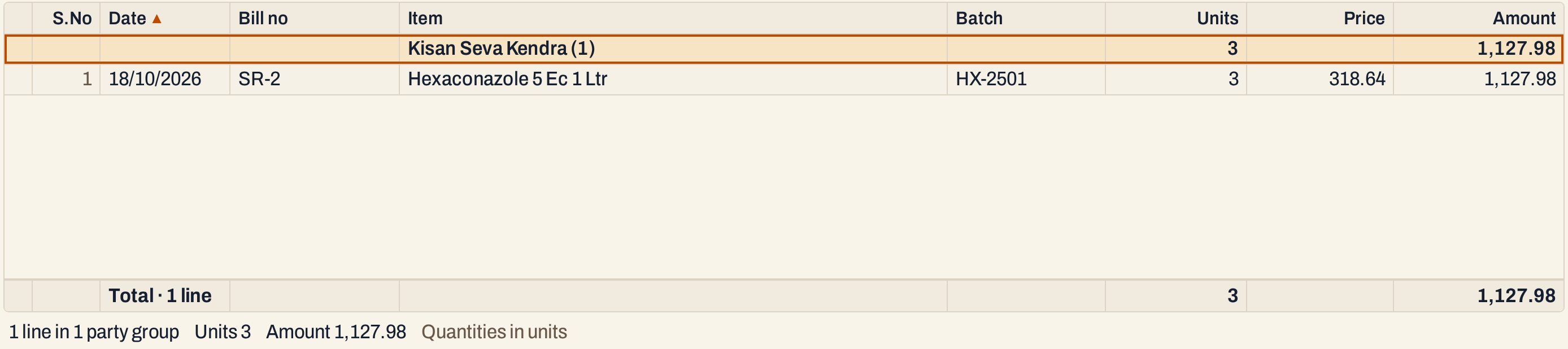 The totals and the status line follow the choice.
Returned from sales
Choose Dealers or Farmers to see the sale each return came from. Dealers lists customers whose account type is Customer or Customer - Supplier; Farmers lists customers whose account type is Farmer. Returns by customers of the other kind are left out, and the customer is shown by name, not by delivery name.
For each return line SimplyERP looks through the same customer’s sale lines for the same item, newest first. The sales are not limited to the period: any sale bill counts. A sale line is used for one return line only. SimplyERP takes sale lines, newest first, until their units cover the units returned, and shows the last one it took: its bill, date, units, price and amount. When the customer has no sale of the item, or all their sales of it together are fewer units than the return, the sale columns stay blank. The Payment and GST choices do not apply to the sales.
In the example, SR-1 returns 2 units of Acephate 75 Sp 500 Gm for Ramaiah K, and the newest sale of it to Ramaiah K is P/286 on 15/10/2026: 4 units at 640.00, 2,560.00 in all. SR-3 returns 1 unit of Thiamethoxam 25 Wg 100 Gm against P/290 on 17/10/2026: 3 units at 210.00, 630.00 in all.
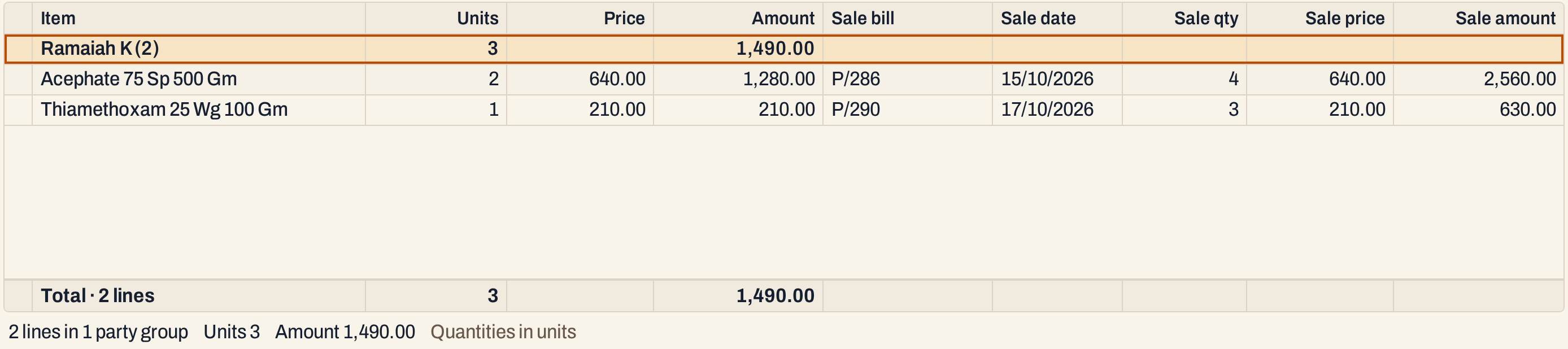 Each return beside the sale it came from. The S.No, Date, Bill no and Batch columns are hidden here to make room.
In a summary, the sale columns are not shown.
Open, mark, print and export
- Enter on a line opens its bill. Enter on a group heading shows only that group’s lines: it sets the Customer, Item or Manufacturer choice to the group and turns Summary off.
- Type the first letters of a name to jump to it: a group heading, or on a line its item (its customer, when grouped by item).
- F2 marks a line and F8 marks them all. F10 then prints only the marked lines.
- F10 prints the report as it is on the screen, titled SALES RETURN STATEMENT, with the customer choice, the period, the unit of the quantities and the choices you made in its heading, including “Returned from sales” when it is on.
- F12 saves it as an Excel workbook.
- Alt+Enter gives the whole window to the list.
To see what was sold in the same period, use the Sales Statement. For the effect of returns on stock, see the Stock Statement.
Updated 4 November 2026.