4 Col Day Book
On this page
The 4 Col Day Book is the whole day’s work on one page. The cash that came in and went out is in the two outer columns, Receipts and Payments. Everything that moved no cash, such as credit bills, bills paid through a bank, bank receipts and payments and journals, is in the two inner columns, Credit and Debit. Each day starts with the cash balance it opened with and ends with the balance it closed on.
A day’s sales are added up by account, not listed bill by bill, so a busy day stays on a screen or two. Use the Cash Book when you want every cash bill and voucher on its own line.
Open the report
Press Alt+4 for Financial Reports, then A. The report opens for the financial year from its first day to today. The pictures show two days, 29-09-2026 and 30-09-2026.
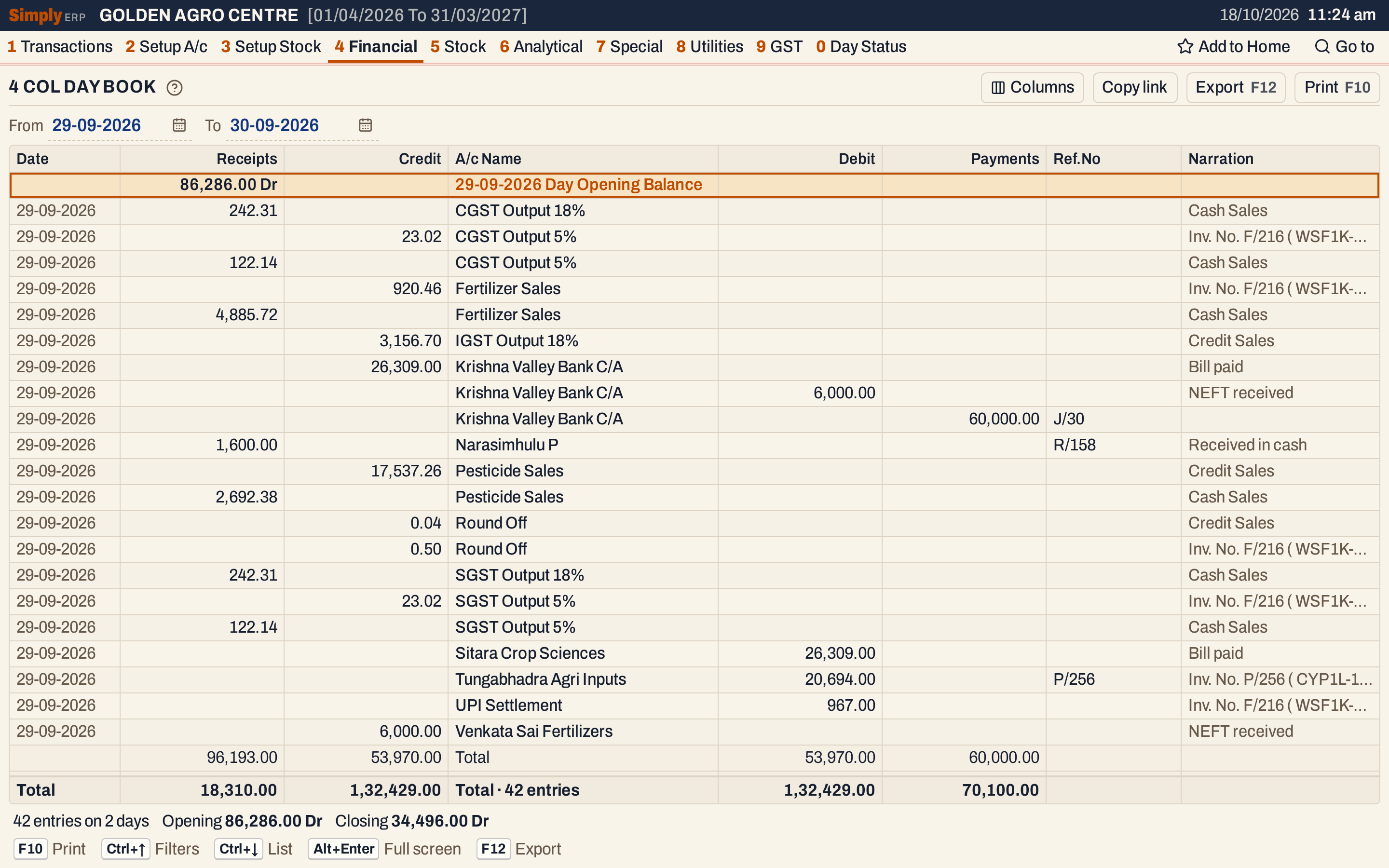 The first day. The day heading carries the opening balance, the lines follow in the order of the account names, and the Total line closes the day.
What it lists
SimplyERP sorts every posting of the period into one of two kinds of column. The money leg of a bill or voucher, the cash or bank account itself, is never a line: the columns add it up.
Receipts and Payments are the cash that came in and went out:
- Bills settled in cash. The bill’s credit postings are Receipts and its debit postings are Payments. The postings to sales, sales return, income, expense, liabilities and current assets accounts (which covers the GST accounts, round off and charges) are added up for the day, one line for each account and kind of document (sale bill, return), with the Narration Cash Sales. Postings to other accounts, such as Purchases, stay one line each with the bill’s number under Ref.No. On 29-09-2026 cash sales made a line of 4,885.72 for Fertilizer Sales and 2,692.38 for Pesticide Sales.
- Cash receipts and payments. The party or expense account of each voucher, one line for each row, with the voucher’s number under Ref.No. R/158 is 1,600.00 received from Narasimhulu P.
- Journals that have a Cash row. Their other accounts. J/30 deposits 60,000.00 from the cash drawer into the bank, so the bank is a Payment of 60,000.00.
Credit and Debit are the postings that moved no cash. Both sides of each document are listed, so the Credit and Debit totals are equal when the books balance:
- Credit bills. The sales, GST, round-off and charge lines of the day are added up for each account under Credit with the Narration Credit Sales. Each customer’s line is one line for each bill under Debit with the bill’s number. A purchase bill is the other way round: the supplier under Credit with the supplier’s own bill number, Purchases under Debit, and the GST input lines added up for the day.
- Bills settled to a bank account, such as a bill paid by card or wallet into UPI Settlement. Their lines are added up for each account and day under Credit, with the narration of one of the bills, and the account the money was paid into is a Debit. Bill F/216 on 29-09-2026 shows as Fertilizer Sales 920.46, CGST Output 5% 23.02, SGST Output 5% 23.02 and Round Off 0.50 under Credit, and UPI Settlement 967.00 under Debit.
- Bank receipts and payments, both sides, one line each. The 6,000.00 NEFT received from Venkata Sai Fertilizers is a Credit to the customer and a Debit to the bank.
- Journals that have no Cash row, both sides. J/31 on 30-09-2026 is Salaries 24,000.00 under Debit and Salary Payable 24,000.00 under Credit.
- Non-GST credit and debit notes, both sides.
Opening balances of accounts are not postings of the day and are not listed.
Columns
| Column | What it shows |
|---|---|
| Date | The day of the line. |
| Receipts | Cash received. On a day’s heading and its Day Closing Balance line, a Dr balance. |
| Credit | The credit side of postings that moved no cash. |
| A/c Name | The account of the line. |
| Debit | The debit side of postings that moved no cash. |
| Payments | Cash paid. On a day’s heading and its Day Closing Balance line, a Cr balance. |
| Ref.No | The voucher’s number (R/158, PY/98, J/30), or the bill’s number on a line that is not added up. Empty for added-up lines and for bank vouchers. |
| Narration | Cash Sales or Credit Sales on added-up lines, otherwise the narration of the bill or voucher: for a sale bill Inv. No. F/216 ( WSF1K-4;UREA45-1; ), the bill number and each item’s code and units. |
The Date, Ref.No and Narration columns can be hidden with Columns.
Choices
| Choice | What it does |
|---|---|
| From, To | The period. Both dates must fall in the financial year. If you set one past the other, the other date follows it. The day balance carries over from before From, so the book can start on any day. |
| Columns | Hides the Date, Ref.No or Narration column. The Excel file leaves them out too, and so does the print for the narration. |
 The choices above the grid. The cash account is the Cash account of the books; there is no account to choose.
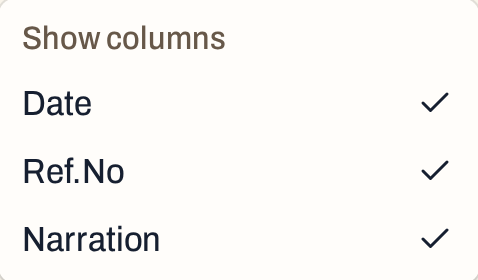 Columns lists the columns you can hide.
Click the title of A/c Name, Ref.No or one of the four amount columns to sort the lines within each day, and click again to reverse. The day headings, totals and balances stay where they are. Every choice is kept in the page address, so Copy link gives a link that opens the same book.
How the figures are worked out
- Day Opening Balance (on each day’s heading, marked Dr or Cr, in the Receipts column when it is Dr and in the Payments column when it is Cr) = the opening balance of the Cash account + all Receipts − all Payments of the days before. This is the balance of the cash in hand. The first day of the period starts from everything before From.
- Total = the day’s lines added up in each column. In the Receipts column the day’s opening balance is added in when it is Dr (in the Payments column when it is Cr), so the Total of the Receipts side less the Total of the Payments side is the closing balance. On 29-09-2026: 86,286.00 + 9,907.00 = 96,193.00 under Receipts, and 60,000.00 under Payments. Credit and Debit are each 53,970.00.
- Day Closing Balance = Opening + the day’s Receipts − the day’s Payments: 96,193.00 − 60,000.00 = 36,193.00 Dr. The next day opens with it.
- The line at the foot adds every line of the period, without the opening balances: 18,310.00 received, 70,100.00 paid and 1,32,429.00 each under Credit and Debit. The status line gives the period’s opening and closing balances: 86,286.00 Dr and 34,496.00 Dr.
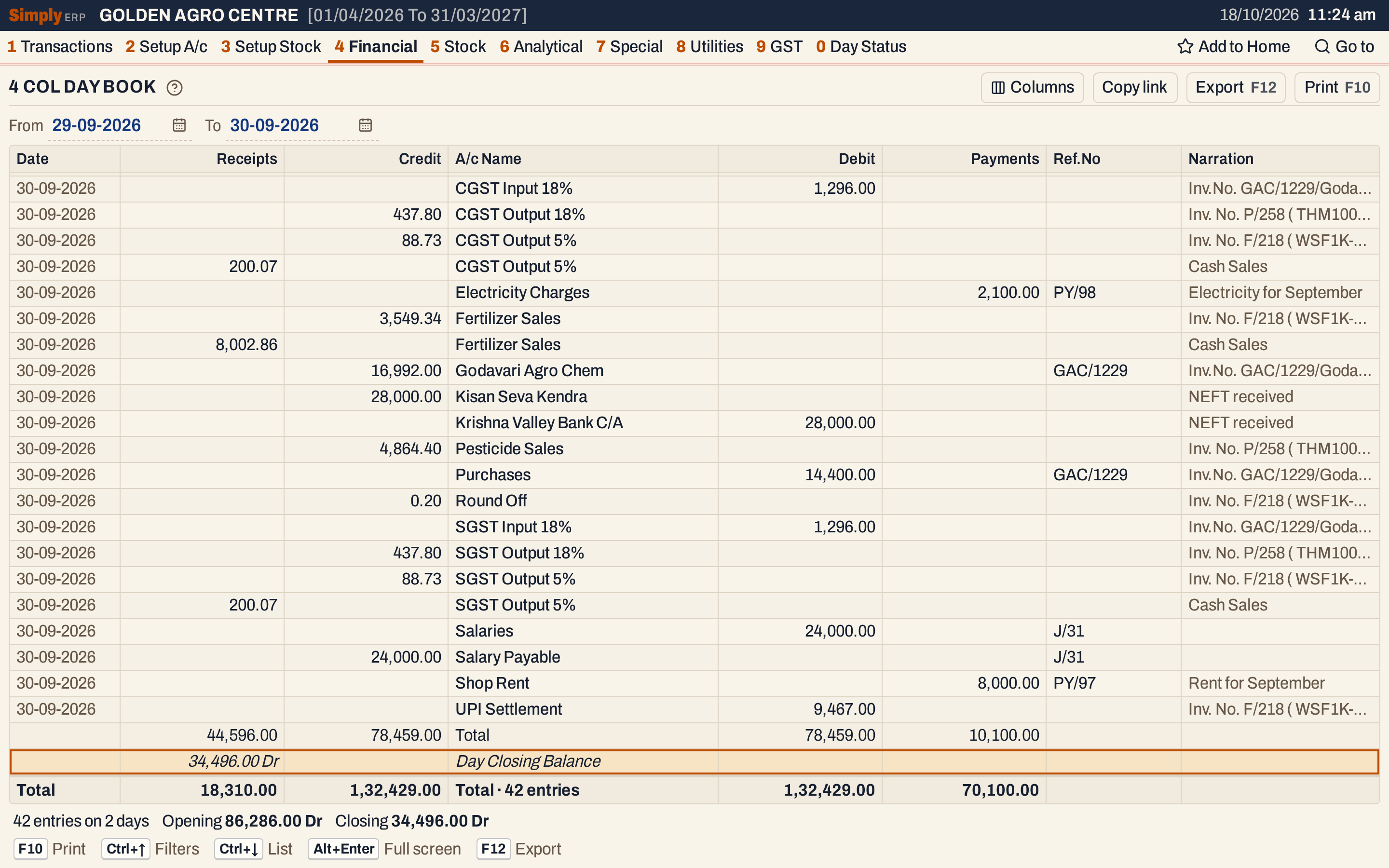 The last day closes at 34,496.00 Dr, the closing balance in the status line.
The balance is the cash in hand, the balance of the Cash account. It is the same closing balance the Cash Book and the Cash Balance Breakup show for the same day. The Cash Day Book differs: it counts bills paid through a bank as money received, and leaves out non-GST credit and debit notes.
Within a day the lines come in the order of the account names. Lines of one account come in the order of their Payments, then Receipts, Debit and Credit, smallest first.
Open, print and export
- Enter on a voucher line opens the voucher, and on a bill line that is not added up it opens the bill. On a line added up for the day, Enter opens that account’s Ledger for the day, where the bills are listed one by one. Back returns to the same line.
- F10 prints the book headed DAY BOOK, with Receipts, Credit, Particulars, Debit and Payments, and the narration under the account name. Each day is a heading in the print. The print closes with the opening balance, the period’s totals and the closing balance.
- F12 saves it as an Excel workbook, with the figures as numbers and the date, Ref.No and Narration in columns of their own.
- Alt+Enter gives the whole window to the list.
Updated 4 November 2026.