C.D. Statement
On this page
The C.D. Statement works out the cash discount a customer has earned by paying early. It takes one customer’s bills, settles them oldest first with the receipts, counts the days each part took to be paid and applies the discount rate you set for that many days. Use it when you give a discount for quick payment and want to see what it comes to for a customer.
The discount is only worked out here. The report never posts it to the books.
Open the report
Press Alt+7 for Special Reports, then X. The report opens for the financial year from its first day to today and asks you to choose the party. All five discount rates are 0 at first, so no discount shows until you set them.
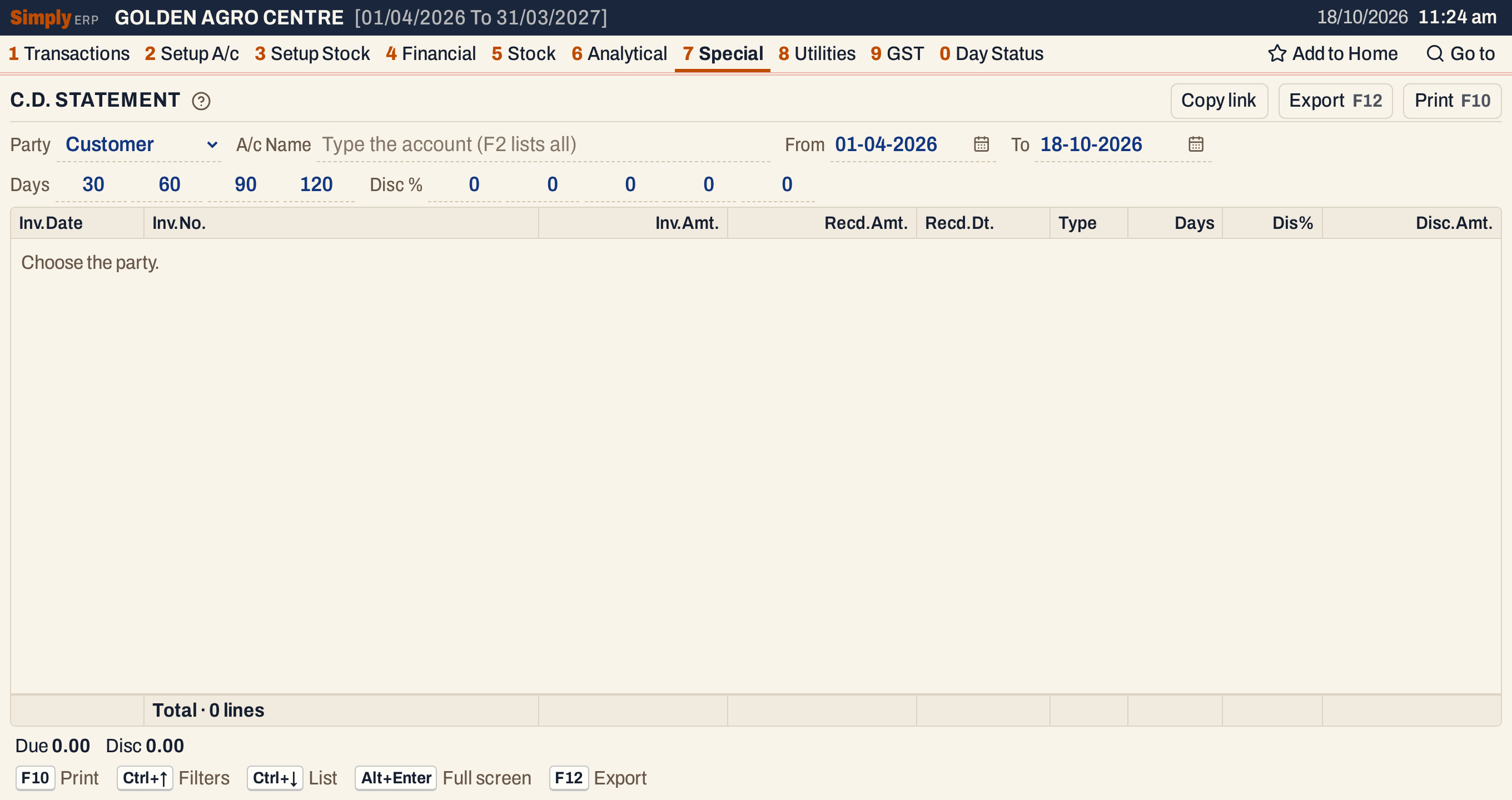 The screen as it opens.
Type part of the customer’s name in A/c Name and the list shows the accounts; F2 lists them all. Enter takes the one highlighted.
 The list holds the accounts of type Customer and Customer - Supplier.
What it lists
The statement is for one customer. It has a line for each part of a bill that a receipt settled, and a line for each bill, or what is left of it, that is not yet settled.
- Bills are the customer’s credit sale bills, at their net amount, and the other debits to the customer’s account, such as a debit note or a journal entry, listed by their voucher number. A cash sale is not a bill here, even when it names the customer. A debit opening balance is the first bill and is listed as Op.
- Receipts are every other credit to the customer’s account: receipts, journal entries, sales returns, credit notes and a credit opening balance. Those of one date and type are added together. They settle the bills in order, the oldest bill first. The Type column shows the type of the entry, such as CR for a cash receipt.
- Only the bills dated from the From date to the To date are listed, but receipts settle the bills of the whole history, and a receipt dated after the To date still settles bills. For a bill that is not yet settled the days run to the To date.
A bill that receipts settle in parts has a line for each part. Every part after the first, and the part not yet paid, carries - Pend. after the bill number.
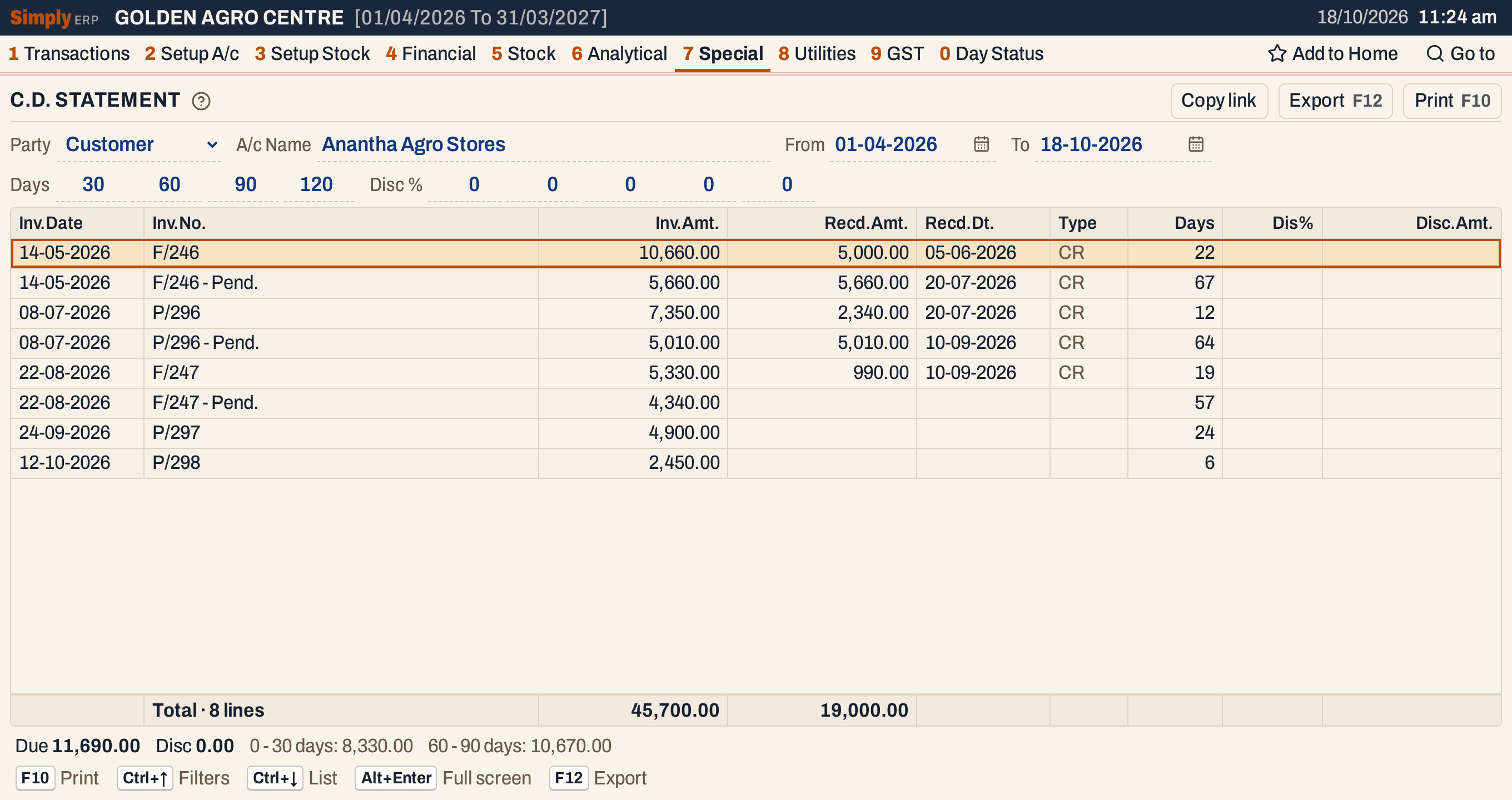 The same eight lines with the discount rates at 0.
Columns
| Column | What it shows |
|---|---|
| Inv.Date | The date of the bill. |
| Inv.No. | The bill number. A line for what remained of a bill after a part was paid has - Pend. after it, repeated once more for each earlier part: a bill paid in three parts has - Pend. - Pend. on its third line. |
| Inv.Amt. | The amount of the bill still unsettled when this part was settled. The first line of a bill is its full amount. |
| Recd.Amt. | The part of it that the receipt settled. Blank for a bill not yet settled. |
| Recd.Dt. | The date of the receipt. |
| Type | The type of the receipt, such as CR for a cash receipt and BR for a bank receipt; OP for a credit opening balance. Blank for a bill not yet settled. |
| Days | The days from the bill date to the receipt date. For a bill not yet settled, the days from the bill date to the To date. A receipt dated before the bill has negative days and takes the first rate. |
| Dis% | The discount rate of the day range the Days fall in. Blank when the rate is 0. |
| Disc.Amt. | The discount on the part: Recd.Amt. × Dis% ÷ 100, to the paisa. |
Choices
| Choice | What it does |
|---|---|
| Party | Customer (the default) or Supplier. This page explains the customer statement. |
| A/c Name | The customer. |
| From, To | The period of the bill dates to list. They open as the financial year’s first day to today. |
| Days | Four day boundaries, 30, 60, 90 and 120 at first. Each is a whole number from 0 to 999 and must not be less than the one before it, except a 0. A 0 after the first boundary leaves its range unused: the days that would fall in it take the rate of the next range. |
| Disc % | Five discount rates, one for each day range, from 0 to 99.99. They are 0 at first. |
If a day boundary is less than the one before it, the report says that each day boundary must be at least the one before it.
Every choice is kept in the page address, so Copy link gives a link that opens the same report.
 The choices above the list. The five rates are for up to 30 days, 31 to 60, 61 to 90, 91 to 120 and over 120.
How the figures are worked out
- The bills are put in order: the opening balance first, then by bill date, then by bill number.
- The receipts are put in order of date, then type, with those of one date and type added together.
- Oldest first. The first receipt settles the first bill. If it is more than the bill, the rest goes to the next bill. If it is less, the bill is settled in part, and what is left of the bill waits for the next receipt. What is left of a receipt after the last bill is settled has no line.
- The days of each part are the receipt date less the bill date. For a bill not yet settled they are the To date less the bill date.
- The rate of a part depends on its days. Up to the first boundary (days 0 to 30 at first) is the first range, above the first boundary and up to the second (31 to 60) is the second range, and so on. Over the fourth boundary is the fifth range. The rate set for that range is the Dis% of the part.
- The discount is Recd.Amt. × Dis% ÷ 100, to the paisa, for every receipt whatever its type. The opening balance earns no discount, and a bill not yet settled has none.
Example: Anantha Agro Stores has five bills and has paid 5,000.00 on 05-06-2026, 8,000.00 on 20-07-2026 and 6,000.00 on 10-09-2026. The rates are 2 percent up to 30 days, 1 percent for 31 to 60 days and 0.5 percent for 61 to 90 days.
- The first 5,000.00 settles part of bill F/246 of 10,660.00, 22 days after the bill. The rate is 2 percent, so the discount is 100.00.
- The 8,000.00 on 20 July settles the rest of F/246, 5,660.00, 67 days after the bill, at 0.5 percent: 28.30. The other 2,340.00 settles part of bill P/296 of 7,350.00, 12 days after it, at 2 percent: 46.80.
- The 6,000.00 on 10 September settles the rest of P/296, 5,010.00, 64 days after the bill, at 0.5 percent: 25.05. The other 990.00 settles part of F/247, 19 days after it, at 2 percent: 19.80.
- What is left of F/247, 4,340.00, and the bills P/297 and P/298 are not yet settled: 4,340.00 + 4,900.00 + 2,450.00 = 11,690.00 is due.
The discount is 100.00 + 28.30 + 46.80 + 25.05 + 19.80 = 219.95.
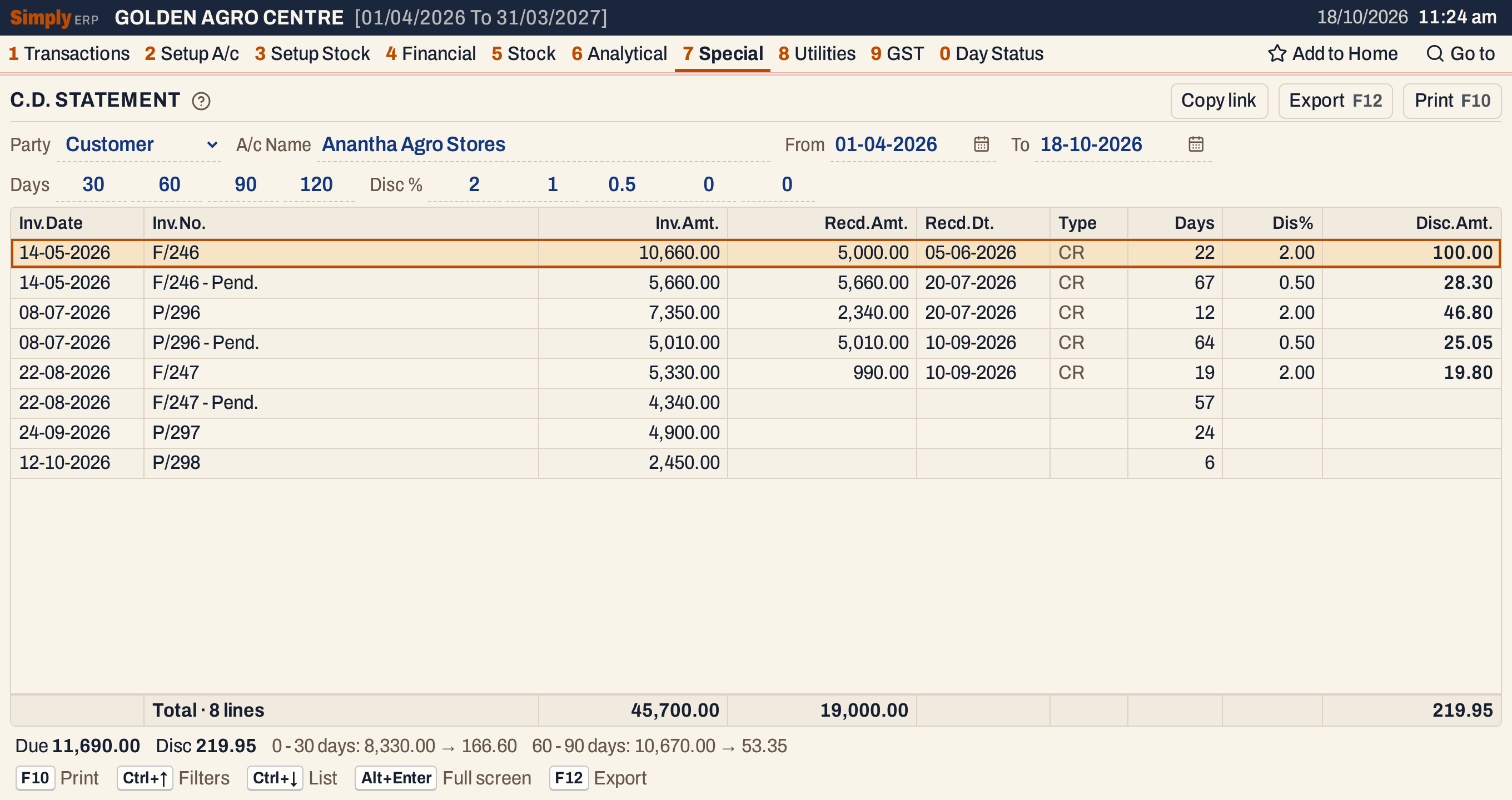 Each part of a bill has the rate of its days. The three unpaid lines have none.
The totals line adds up the columns. The Inv.Amt. total adds the amount of each line, and a bill that was paid in parts has its remainder counted again on the next line, so it is more than the total of the bills.
The line under it shows the amount still due, the total discount, and for each day range with receipts the amount received and the discount on it. These day-range figures count only cash receipts, bank receipts and a credit opening balance. A bill settled by a sales return, a credit note or a journal entry earns its discount in the total, but is not in a day range. The print’s [A/c Summary] works the same way.
 The status line gives the discount of each day range that had receipts.
Open, print and export
- Enter on a line opens the customer’s ledger for the same period.
- F10 prints the statement, headed with the customer’s name and the period, the day boundaries and rates, and a Totals line. Under it the print gives an [A/c Summary] by day range: the cash and bank receipts in each range with its rate and discount, and the opening balance when there is one.
- F12 saves it as an Excel workbook. The Type and Dis% columns are in the workbook but not on the print.
- Alt+Enter gives the whole window to the list.
Updated 4 November 2026.